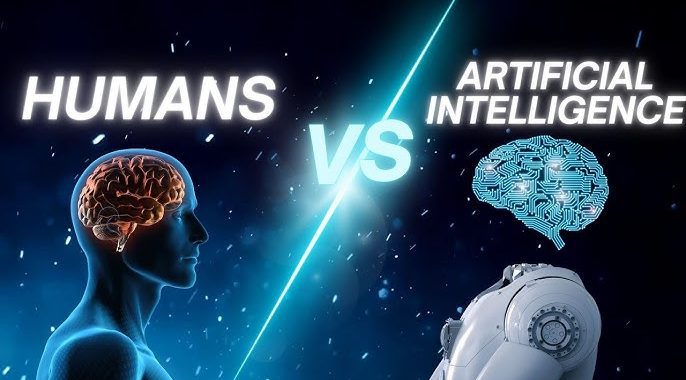
In the 21st century, Artificial Intelligence (AI) has become one of the most transformative innovations, reshaping industries, education, healthcare, and even personal lifestyles. From self-driving cars to voice assistants like Siri and Alexa, AI is now a daily part of human interaction. While AI is often designed to mimic human intelligence and decision-making, it is fundamentally different from human beings in many ways. To truly understand these differences, it’s important to explore the contrasts in learning, creativity, emotions, adaptability, and decision-making between AI and humans.
1. Learning Ability
One of the most striking differences between AI and human beings lies in how they learn. AI learns through data, algorithms, and programming. Machine learning models are fed with massive amounts of structured and unstructured data, and they use this information to identify patterns, make predictions, and perform tasks. For example, a facial recognition system can be trained to recognize thousands of faces by analyzing millions of images.
Humans, on the other hand, learn through experience, observation, reasoning, and intuition. Unlike AI, humans don’t require thousands of repetitive examples to learn something new. A child, for instance, can learn to recognize a dog after just a few interactions, using a combination of senses, memory, and logic. This natural ability to learn from limited data and generalize knowledge to new situations makes human learning far more flexible and adaptive than AI-driven learning.
2. Creativity and Innovation
AI can generate music, write stories, create designs, and even paint images. However, the creativity AI demonstrates is fundamentally different from human creativity. AI relies on existing datasets and algorithms to create something that seems original but is essentially a recombination of what it has already learned. For instance, an AI art generator can produce beautiful paintings, but these are based on patterns it has been trained on.
Humans, however, possess true creativity that comes from imagination, emotions, culture, and lived experiences. Humans can create ideas that have no prior reference, such as inventing a new scientific theory or writing a novel that reflects deep emotions and unique perspectives. While AI mimics creativity, human creativity stems from originality, inspiration, and emotional depth, something machines cannot replicate authentically.
3. Emotions and Empathy
Another major difference is the presence of emotions. Human beings are deeply emotional creatures. Our thoughts, decisions, and relationships are guided by feelings like happiness, sadness, empathy, fear, and love. These emotions play a significant role in human decision-making and behavior. For example, a doctor comforting a patient uses not just knowledge but also empathy to connect with them.
AI, however, lacks genuine emotions. While chatbots and virtual assistants can be programmed to respond empathetically, this is only an imitation of human emotion. AI cannot “feel” sadness, joy, or compassion—it can only simulate such responses based on data. This lack of real emotional depth limits AI’s ability to connect with humans in the same authentic way that humans connect with each other.
4. Decision-Making
AI decision-making is based purely on logic, algorithms, and statistical probability. When provided with accurate data, AI can make faster and more precise decisions than humans. For example, in stock market predictions or medical image analysis, AI can process vast amounts of information in seconds and provide results with high accuracy.
Humans, however, combine logic with intuition, ethics, and personal judgment. A human might decide against a profitable business move because it is morally wrong or harmful to society. Unlike AI, which follows programmed rules, humans have the ability to weigh moral consequences, cultural values, and emotional impacts in their decision-making. This makes human decision-making more holistic and value-driven compared to AI’s purely data-driven approach.
5. Adaptability and Flexibility
AI systems are often limited to specific tasks. For example, an AI trained to play chess cannot automatically shift to playing soccer without being reprogrammed. This is called “narrow AI,” where machines excel at one specific task but cannot generalize their intelligence across multiple domains.
Humans, however, are naturally adaptable. A person can learn new skills, switch careers, or handle unexpected situations with creativity and problem-solving abilities. Human intelligence is not limited to a narrow field but spans across diverse areas, allowing people to survive and thrive in changing environments. This general intelligence is one of the biggest advantages humans have over AI.
6. Physical and Biological Differences
AI operates through machines, servers, and codes. It does not require food, sleep, or rest like humans. Machines can work 24/7 without fatigue, making them highly efficient in repetitive and labor-intensive tasks.
Humans, however, are biological beings with limitations. Fatigue, illness, and the need for rest can reduce efficiency. Yet, these biological needs are also what make humans unique. Sleep, for instance, allows the brain to process emotions and consolidate memory—something AI does not need but also cannot replicate in the same way. The biological nature of humans brings both limitations and strengths, such as empathy, resilience, and the ability to evolve over generations.
7. Ethics and Morality
AI does not possess its own moral compass. It acts based on the data and instructions given by humans. If biased or unethical data is fed into an AI system, its outcomes will reflect those biases. For example, AI hiring tools have sometimes shown gender or racial bias because of the biased data they were trained on.
Humans, on the other hand, have an inherent sense of ethics and morality, shaped by culture, religion, and personal beliefs. People can consciously decide what is right or wrong, even when it goes against logic or profit. This ability to act based on ethical and moral principles is something AI cannot achieve without human guidance.
8. Consciousness and Self-Awareness
Perhaps the most profound difference is consciousness. Humans are self-aware beings with a sense of identity, purpose, and existence. We can reflect on our thoughts, question our actions, and search for meaning in life.