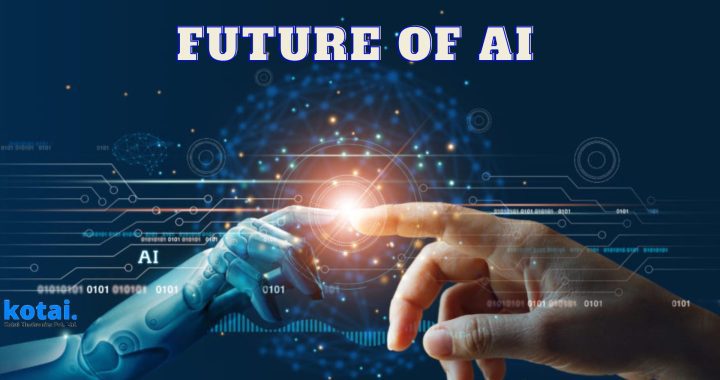
The Future of Artificial Intelligence : brimming with Opportunities and Challenges What Lies Ahead
Artificial Intelligence (AI) has shifted from being just a futuristic concept in science fiction to becoming an everyday reality in our lives. From the voice assistants on our smartphones to recommendation engines on streaming platforms, AI already plays a significant role in shaping how we live, work, and interact. Yet, what we are experiencing now is only the tip of the iceberg. The future of AI promises breakthroughs that could revolutionize industries, economies, and even the way humans perceive intelligence itself. In this blog, we will explore the possibilities, challenges, and outlook for AI in the years to come.
1. The Growing Role of AI in Everyday Life
AI is steadily embedding itself into our daily routines. In the future, we can expect this integration to become even deeper. Smart homes will evolve from simply controlling lights and thermostats to becoming fully intelligent environments that anticipate our needs, improve energy efficiency, and enhance security. Healthcare apps powered by AI could monitor vital signs in real-time, detect illnesses before symptoms appear, and recommend lifestyle changes tailored to individuals.
Additionally, AI assistants may advance beyond performing tasks based on commands. They could function as digital companions, capable of learning emotional cues, offering mental health support, and providing personalized advice. The blending of AI into personal lives may blur the line between machines and human interaction, raising both excitement and ethical questions.
2. AI in the Business and Industrial World
The corporate world is already leveraging AI to automate processes, reduce costs, and improve decision-making. In the future, AI will redefine industries at an unprecedented scale. For instance:
Healthcare: AI could enhance precision medicine by analyzing a patient’s genetic makeup to prescribe highly personalized treatments. Robotic surgeons guided by AI may perform complex surgeries with unmatched accuracy.
Finance: Fraud detection, algorithmic trading, and personalized financial planning will rely even more on intelligent systems. AI could also democratize access to investment advice, making wealth management available to more people.
Manufacturing: Smart factories, powered by AI-driven robotics and predictive maintenance, will increase efficiency while reducing human risk in hazardous environments.
Retail: Hyper-personalized shopping experiences will become the norm, where AI predicts consumer needs before they arise.
AI won’t just optimize industries; it will create entirely new business models and markets.
3. The Future of Work and Employment
One of the most debated aspects of AI’s future is its impact on jobs. Automation is expected to replace certain roles, particularly repetitive or manual tasks. However, history shows that while technology eliminates some jobs, it also creates new ones. The future of work will likely involve humans collaborating with AI systems rather than competing against them.
Workers may need to develop new skill sets, emphasizing creativity, problem-solving, and emotional intelligence—areas where humans have an edge over machines. Governments, educational institutions, and organizations must prepare the workforce through reskilling programs to adapt to an AI-driven economy. Instead of fearing job loss, society should focus on opportunities for humans and machines to work in synergy.
4. Breakthroughs in AI Research
The next decade is expected to bring major advancements in AI research. Some key areas include:
Artificial General Intelligence (AGI): Current AI is narrow, excelling at specific tasks. Future research is aimed at creating AGI, systems capable of human-like reasoning and learning across diverse domains. While AGI remains a long-term vision, its achievement would mark a turning point in human history.
Explainable AI (XAI): As AI makes more critical decisions, transparency will become vital. Future AI systems will be designed to explain their reasoning, helping humans trust and validate their outputs.
AI and Creativity: Beyond automation, AI may emerge as a co-creator in art, music, literature, and design, pushing the boundaries of what creativity means.
Neuromorphic Computing: Inspired by the human brain, neuromorphic chips could make AI faster, more energy-efficient, and capable of processing information in ways closer to human cognition.
These breakthroughs will expand AI’s potential but also require careful oversight to prevent misuse.
5. Ethical and Social Challenges
As AI grows more powerful, ethical considerations will become central to its development. Issues such as bias in algorithms, data privacy, surveillance, and accountability must be addressed. For example, if an autonomous car makes a life-or-death decision in an accident, who is responsible—the manufacturer, the programmer, or the AI itself?
Another concern is the possibility of deepfakes and misinformation. AI tools can manipulate images, audio, and video with alarming realism, raising questions about trust in digital information. To safeguard society, governments and tech leaders must establish global regulations, ethical frameworks, and transparent practices.
6. AI and Human Augmentation
In the future, AI won’t just exist outside us—it could integrate with the human body. Brain-computer interfaces (BCIs) are being developed to allow direct communication between humans and machines. This could help people with disabilities regain mobility or speech, and even enhance human memory and cognitive capabilities.
Such augmentation raises both thrilling possibilities and ethical dilemmas. Will enhanced humans create new social divisions? How do we regulate technology that merges biological and artificial intelligence? These questions highlight the need for thoughtful governance as technology advances.
7. Global Impact of AI
AI will not only reshape industries and societies but also influence geopolitics. Nations leading in AI research and innovation will have significant economic and strategic advantages. Countries are already investing heavily in AI to strengthen defense systems, healthcare infrastructure, and economic competitiveness.
At the same time, global cooperation will be essential. Shared frameworks on AI ethics, cross-border regulations, and collaborative innovation could prevent misuse while ensuring equitable benefits across nations. The future of AI is not just a technological issue but also a diplomatic one.
Conclusion: A Future Shaped by Choice
The future of AI is filled with promise and potential, but it is not predetermined. Whether AI becomes a force for good or a source of disruption will depend on how humanity chooses to develop, regulate, and use it.